


Which log splitter?
How do I decide / work out which log splitter I need?
CLICK ON THE PICTURE FOR HELP WITH DECIDING

Description
Regrettably, our log splitters are not made in the UK but in Europe and are therefore considerably more expensive than the plethora of Chinese log slitters on the market. For this reason, the starting point is to ask you if you wish to avoid purchasing a Chinese log splitter, in which case please read on 😊.
The force needed to split wood varies a lot, so when choosing a log splitter consider the following. It’s not all about price but more about making the job as easy and quick as your budget will allow.
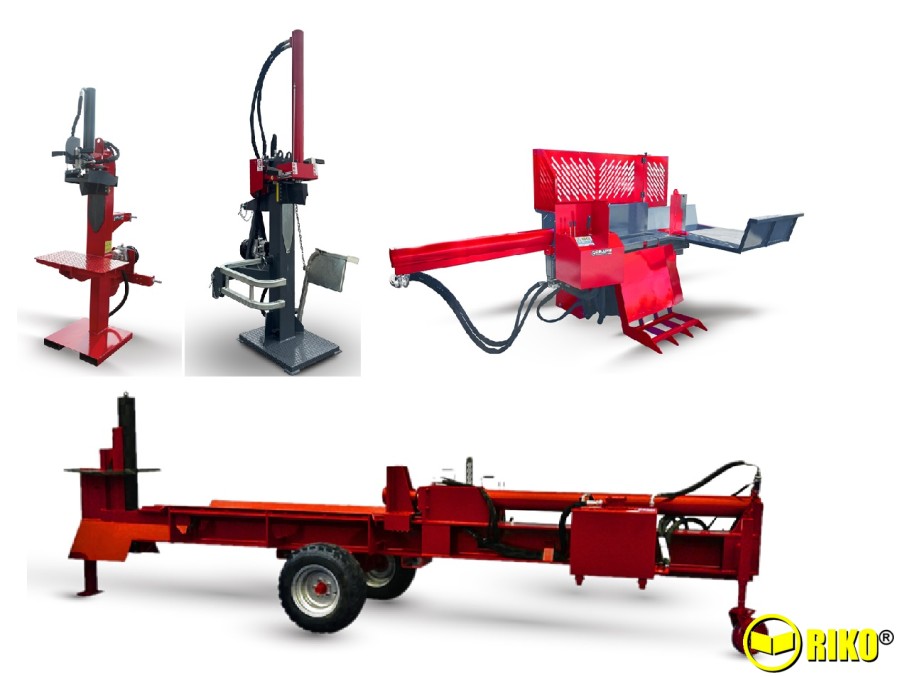
An overview of vertical and horizontal log splitters.
Vertical Log Splitters vary in splitting length / stroke from around 45cm to 120cm. The shorter stroke splitters usually have a fixed table around waist height. To make large diameter timber easier to handle it is often cut into rings. Smaller diameter timber can be split into two logs. Larger diameter is cut as if you were cutting slices of a cake.
The longer stroke vertical log splitters can have an adjustable height table that can also be removed so you can split long wood up to 110cm high. With the table removed the longer length of timber can be split full length into 'Billets'. Most longer stroke vertical log splitters have a lifting arm so that when the table is removed the lifting arm can be used to stand the timber up on its end. Once split into billets each billet can then be cut into logs straight away or the billets can be left to season and then cut into logs once dry.
Horizontal Log Splitters vary in splitting length / stroke from around 45cm upwards to a maximum of 2.5M or even 3m in length. Whilst they can be used to split individual or even multiple rings of timber, they are more commonly used for splitting into Billets or reducing large diameter timber into smaller diameter pieces so they can then be fed through a firewood processor.
Riko horizontal log splitters come in various standard lengths but can be specially ordered to take the log length the customer wants. For example, our standard build COL-SO-1200-14-C horizontal splitter is 14 tons and takes timber up to 1.2 meters long but could be supplied with a splitting length as short as 50cm or as long at 2.5 or even 3 metres. For example, our COL-SO-2500-50 has a splitting length of 2.5 metres and a splitting force of 50 tons.
Using a long length horizontal splitter, to create Billets or to ‘break down’ larger diameter timber into smaller diameter pieces is very common in Europe and sounds appealing. However, continental timber tends to have far less knots and twists as it is often grown and managed to be of milling quality. Whereas UK large diameter timber is rarely well managed and is often very knotty and twisted. If you are considering buying a large capacity horizontal splitter for reducing large diameter timber to then put through a processor, then please remember that a long length of large diameter, knotty & twisted UK timber is very unlikely to split into nice long lengths!
If the timber is very bad with lots of knots and twists, or is seasoned, then you will need more power for the diameter. Especially if it is seasoned as most hard woods such as Oak, becomes harder as it seasons and can be very hard to split.
When a vertical splitter is available with a 4-way knife, you should consider the splitting force in relation to the length of splitting knife. IE. If an 18-ton splitter has a single two-way split knife that is 16" tall then the splitting force is 18 divided 16 = 1.125 tons per inch of blade. This means that with an 16" diameter piece of timber the force is only 1.125 tons per inch of timber. If you then have a 4 way knife the total length of knife will be something like 32" so the equation becomes 18 divided by 32 = 0.5625 tons per inch of blade engaged with 16" diameter timber.
Don't be fooled into thinking that a big powerful splitter will easily split big diameter timber. For example, on a 50-ton horizontal splitter when the four-way knife is fully down in the two way split position, the knife height is say 24". The equation is therefore 50 divided by 24 = 2.08 tons per inch of blade. So, with 24" diameter timber it is 2.08 tons engaged with each inch of timber. Raise the knife up to split four ways and the total knife length engaged with the timber is around 48" so the equation becomes 50 divided by 48 = 1.04 tons engaged with each inch of timber.
In reality it means that the smaller the diameter of timber and the less knotty it is, then the more successful you will be with splitting it into for equal quarters. The last thing you want is to have a large diameter piece of knotty hard timber stuck mid split on a four-way knife!
To help you decide what size log splitter you need, the following guide may help. It is based on splitting green, average / good timber, the maximum length the splitter will take and with a single knife into two pieces. They will of course split bigger diameter timber, but this is a general guide. The length of timber will vary depending on the make of log splitter the length stated are based our most common splitters.
Vertical splitters:
10-13 ton = 10-40cm diameter & up to 110cm long.
14-18 ton = 40-60cm diameter & up to 110cm long.
19-25 ton = 60-80cm diameter & up to 110cm long.
26-30 ton = 60-100cm diameter & up to 100cm long.
Horizontal splitters
12 ton = 30-40cm diameter & 70-110cm long.
14-16 ton = 40-60cm diameter & 70-160cm long.
22 ton = 60-80cm diameter & 70-250cm long.
30 ton = 60-100cm diameter & 100-250cm long.
40 ton = 60-120cm diameter & 100-300cm long.
50 ton = 50-140cm diameter & 100-300cm long.
If you would like us to offer advice on which log splitter is best for you, then please answer the following questions:
- Is it for commercial or private use?
- What timber, i.e. hardwood or softwood?
- What diameter timber?
- What length of timber do you want to put on the splitter?
- What length do you usually cut your logs to?
- How do you want to power the log splitter? Electric, petrol engine, tractor powered by PTO or tractor powered by the tractor hydraulics?
- If it is a tractor one, what model & horsepower tractor do you have?
If you have any questions at all then please do get in touch.